
Escrito por Maximiliano Morales El otro día estaba hablando con el historiador Alex Ovalle Letelier…
From Manual Irrigation to Smart Control: Why Nurseries and Greenhouses Need to Automate Now
The water crisis has stopped being a future threat and has become a permanent operating condition for agriculture. In central-northern Chile, production no longer depends only on land, infrastructure, or experience—it now depends on using every liter of water with greater precision, less margin for error, and more responsiveness.
In this context, nurseries and greenhouses face direct pressure. They are intensive, sensitive, and high-value production systems, where a poor irrigation decision can affect seedlings, grafts, vegetables, flowers, hydroponic forage, or entire protected crops.
The problem is clear: many systems still rely on manual irrigation, fixed schedules, or decisions made “by eye.” That model no longer matches today’s climate reality.
Automation is no longer an upgrade: it’s operational continuity
In nurseries and greenhouses, irrigation cannot depend solely on operator availability or a timer. Temperature changes, relative humidity fluctuates, substrates behave differently depending on the crop, and each production stage requires specific conditions.
That’s why agricultural automation with artificial intelligence allows a shift from reactive operations to data-driven operations.
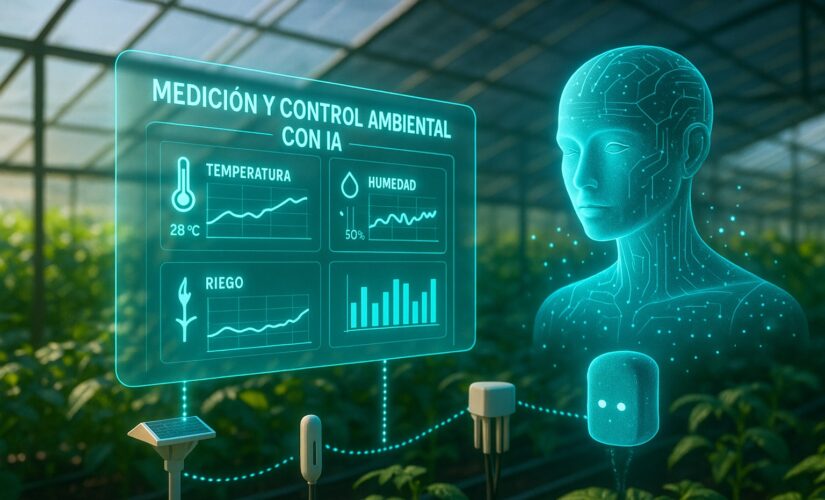
IMBERT Labs develops systems that measure critical variables in the production environment, interpret that data, and execute actions on pumps, valves, irrigation systems, fertigation, and climate control.
The logic is simple:
measure → decide → execute → record
This allows the system not only to observe what is happening, but to act when needed and keep traceability of every decision.
Less water waste, less human error, more control
For a nursery, precision can make the difference between uniform production and significant losses. In a greenhouse, over-irrigation can saturate the substrate, increase disease, waste water, and raise energy costs. Irrigating too late can cause water stress and affect growth, quality, and yield.
Smart automation helps reduce that margin of error.
According to Maximiliano Morales, Agronomist of Imbert Labs, ¨The system can work with sensors for moisture, temperature, relative humidity, pressure, flow, water level, and other parameters depending on the farm’s needs. Based on that data, IMBERT enables irrigation and fertigation processes to be activated or adjusted according to real conditions—not just predefined schedules.¨
The result is a more stable, efficient operation that is less dependent on constant supervision.
Artificial intelligence applied to real-world agriculture
IMBERT Labs’ approach goes beyond installing sensors or displaying data on a screen. The real value lies in turning that data into operational decisions.
Francois Rojo, Operations Manager of Imbert Labs says that Artificial intelligence makes it possible to analyze the behavior of the production system, detect meaningful variations, and support decisions related to water management, climate, and operations. This is especially important in contexts where water is scarce, costs are rising, and producers need to justify every investment with tangible results.
As explained by Matías Pastén, General Manager of IMBERT Labs: “Optimizing irrigation is no longer a luxury. In regions like Coquimbo, Atacama, and much of central-northern Chile, every irrigation decision has economic and productive impact. Our goal is for farmers to stop operating blindly and to control their systems with real data, automation, and traceability.”
Direct benefits for nurseries and greenhouses
Water and energy savings
By reducing unnecessary irrigation, the use of pumps, energy, and infrastructure wear also decreases.
Greater production uniformity
A more controlled system delivers more consistent conditions to plants, reducing variability across areas.
Reduced dependence on manual operation
Automation reduces repetitive tasks and frees up time for higher-value work.
Response to climate events
The system adapts better to changes in temperature, humidity, and critical greenhouse conditions.
Traceability and reporting
Every decision is recorded, enabling useful reports for internal management, financing, certifications, clients, or support programs.
Adaptable to existing infrastructure
One of IMBERT’s key strengths is that the technology can be implemented according to each producer’s reality. In some cases, the system can connect to existing infrastructure such as pumps, valves, electrical panels, or installed irrigation systems. In others, new sensors, actuators, or control layers can be added depending on the required level of technification.
This allows for gradual implementation, without forcing the farmer to replace everything from day one.
The goal is not to complicate operations, but to make them simpler, measurable, and controllable.
A new way of operating nurseries and greenhouses
The future of agriculture will not be defined only by who has more land or infrastructure, but by who can operate with greater precision under scarcity conditions.
For nurseries and greenhouses, automating irrigation, fertigation, and climate control is no longer optional. It is a way to protect production, reduce losses, and prepare agricultural businesses for a scenario where water, energy, and traceability will become increasingly decisive.
At IMBERT Labs, we work so that production systems can take better care of themselves—even when no one is watching.
The future of agriculture is not about irrigating more. It’s about deciding better.
Agricultural automation with artificial intelligence for nurseries, greenhouses, and open-field crops.
WhatsApp: +56 9 3251 7848
Email: contacto@imbertspa.com
Website: imbertspa.com

Entradas relacionadas



Comments (0)