
As your company grows, so does the complexity of managing: 🔐 Personal and sensitive data 💳…
Forage Crisis in the Coquimbo Region: When Livestock Cannot Wait
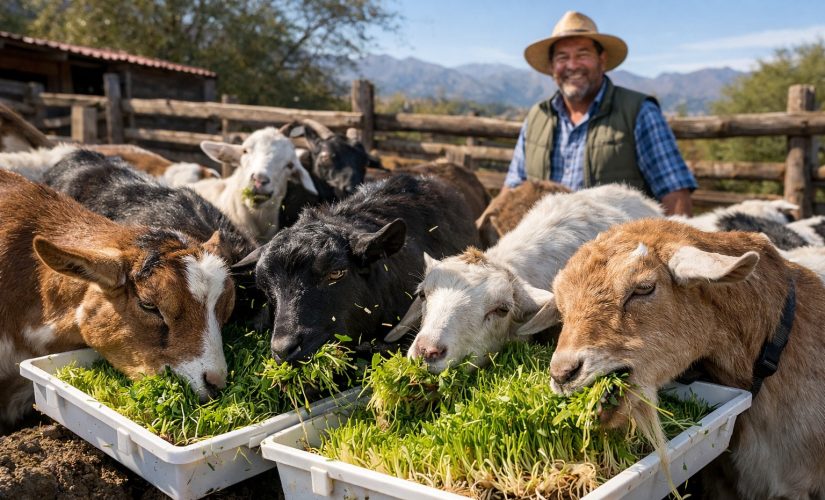
In the Coquimbo Region in Chile, water scarcity has stopped being a temporary challenge and has become a permanent condition. For goat and sheep farming, this translates into something simple and brutal: when forage becomes scarce or expensive, the entire operation becomes fragile. It is not only a production problem; it is a continuity problem.
In this context, many livestock producers have had to make difficult decisions—adjust stocking rates, reduce herd size, change feeding routes, or rely on increasingly uncertain purchases. And although alternatives exist, many of them hit the same wall: they require time, water, and stability—exactly what is lacking today.
The question therefore changes. It is no longer only “how to produce more,” but how to secure a constant supply of feed in an environment where climate, water, and costs have stopped being predictable.
Hydroponic Forage: Efficiency and Continuity in a Constrained Environment
One response gaining relevance in water-stressed regions is hydroponic forage: producing green feed in short cycles, within a controlled space, with optimized water consumption and without depending on pasture availability or rainfall.
Its value is not in promising miracles, but in providing continuity. Instead of relying entirely on logistics or the climate cycle, producers can secure a portion of their feed supply through a controlled operation. This reduces exposure to external shocks and provides a concrete tool to stabilize the production system.
However, hydroponic forage comes with a well-known caveat: it requires consistency to work well. Humidity control, ventilation, irrigation, temperature management, and an organized process are essential. When these factors are managed “by eye” or with intermittent supervision, common failures appear: uneven trays, excess humidity, sanitary issues, or losses due to irregular handling.
That is where technology stops being optional and becomes an enabling condition.
Automation: The Difference Between Trying and Sustaining
To address these challenges, the Ovalle-based company IMBERT Labs developed IMBERT Core Plug & Play, a technology that allows producers to automate the microclimate and irrigation of controlled production systems in a practical way, without requiring them to become experts in sensors or programming.
The system measures key variables, validates data quality, makes decisions, and executes actions consistently. This reduces dependence on the operator for repetitive tasks that, when they fail, can be costly.
This approach has an important implication: each installation generates real data from its specific location and operation. Instead of relying on generic parameters taken from manuals, producers can progressively adjust the system according to real conditions. The result is operational learning—better decisions over time because local evidence is being built, not just theoretical assumptions.
In addition, automating a forage production system also means addressing operational continuity. For that reason, the technology is designed to keep operating even when the surrounding environment is imperfect. In the event of outages or contingencies, backup energy systems can be incorporated and dimensioned according to the size of the installation and device load, helping maintain continuity in critical operations. The key is not to promise fixed autonomy, but to design resilience case by case.
Finally, there is a point that is often overlooked: in the field, what usually kills the adoption of this kind of technology is not the idea itself, but abandonment and lack of consistency. Technology only works if it is sustained over time.
For this reason, the Imbert Labs model includes operational continuity and support through a specialist who assists with monitoring, updates, and remote assistance—ensuring that producers are not left alone when something fails or needs adjustment.
The water crisis is pushing agriculture toward a new standard: efficiency and control. In livestock production, that means securing feed with less water and less dependence on external variables.
In this context, hydroponic forage is a concrete alternative—but its sustainability depends on a stable operation. And in many cases, that stability is achieved through well-designed automation.
The key is understanding the signal: in a world that has changed, the solutions that survive are not those that simply “look innovative,” but those that ensure continuity when everything else becomes uncertain. 🌱🐐
Contact: contacto@imbertspa.com
WhatsApp: +56 9 3251 7848 📩📱

Entradas relacionadas


Comments (0)