
Escrito por Maximiliano Morales El otro día estaba hablando con el historiador Alex Ovalle Letelier…
Chile Strengthens Its Position as an Emerging Aerospace Development Hub in Latin America
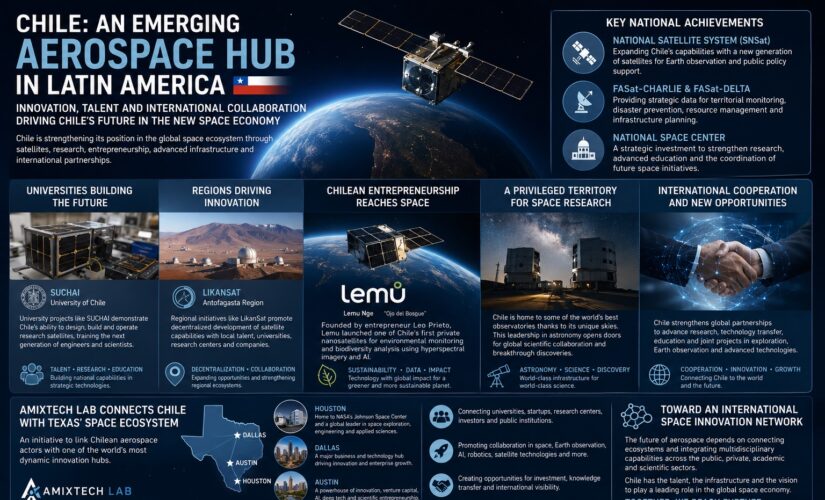
The country is advancing in satellites, Earth observation, scientific research, technological entrepreneurship, and international cooperation to strengthen its role in the new space economy.
Chile is experiencing one of the most significant periods in its history in terms of aerospace development. The convergence of scientific capabilities, technological infrastructure, astronomical observation, innovation, and entrepreneurship is driving the creation of an ecosystem that aims to position the country as a strategic player within the global space economy.
Over the past few years, major advances have been made to strengthen national capabilities in Earth observation, environmental monitoring, emergency management, telecommunications, scientific research, and technological development.
One of the most important milestones is the implementation of the National Satellite System (SNSat), an initiative designed to expand the country’s space capabilities through a new generation of satellites dedicated to Earth observation and the support of public policy initiatives.
This effort is complemented by the operation of the FASat-Charlie and FASat-Delta satellites, which provide strategic information for territorial monitoring, natural disaster prevention, natural resource management, and infrastructure planning.
At the same time, the development of the National Space Center represents one of the country’s most significant investments in the sector, creating a platform dedicated to strengthening research, advanced human capital development, and the coordination of future space initiatives.
Universities Driving the Development of New Capabilities
Chilean universities have played a fundamental role in building the national aerospace ecosystem.
Projects such as SUCHAI, developed by the University of Chile, have demonstrated the country’s ability to design, build, and operate research satellites while contributing to the education and training of engineers, scientists, and space technology specialists.
These initiatives have enabled students and researchers to participate directly in highly complex technological projects, strengthening applied knowledge and building national capabilities in strategic areas.
Regional Participation Expands Chile’s Space Development
The growth of the aerospace sector is not limited to Santiago.
Several regions are promoting initiatives aimed at strengthening technological and scientific decentralization. Among them is the LikanSat project in the Antofagasta Region, which seeks to develop satellite capabilities from northern Chile through the participation of universities, research centers, and technology companies.
Projects such as LikanSat contribute to expanding the country’s pool of specialized talent and creating new innovation opportunities linked to regional needs and challenges.
Chilean Technological Entrepreneurship Reaches Space
The private sector is also playing an increasingly important role within Chile’s aerospace ecosystem.
One of the most notable examples is Lemu, a company founded by Chilean entrepreneur Leo Prieto, which successfully launched the Lemu Nge nanosatellite into orbit. The mission is considered one of the first privately developed satellite initiatives from Chile focused on environmental monitoring and biodiversity conservation.
The project combines hyperspectral imaging and artificial intelligence to collect data on forests, water resources, carbon, and ecosystems, generating tools that support environmental conservation and data-driven decision-making.
Lemu Nge demonstrates Chile’s capacity to develop globally relevant space technologies while integrating sustainability, science, innovation, and entrepreneurship.
A Privileged Territory for Space Research
Chile possesses exceptional conditions for activities related to the space industry.
The country is home to some of the world’s most advanced astronomical observatories, located in the northern regions thanks to the unique quality of its skies and atmospheric conditions.
This scientific infrastructure positions Chile as one of the leading global centers for astronomical research and observation of the universe, creating opportunities for collaboration with world-class scientific institutions.
The combination of astronomy, artificial intelligence, data analytics, Earth observation, advanced sensors, and satellite technologies opens new possibilities for economic and scientific development.
International Cooperation and New Opportunities
The advancement of Chile’s aerospace ecosystem has also been accompanied by growing international collaboration.
Public institutions, universities, research centers, and technology companies have strengthened relationships with international organizations to promote research programs, technology transfer, specialist training, and the development of joint projects.
Chile’s participation in global initiatives related to space exploration, Earth observation, climate monitoring, and advanced technologies expands access to knowledge, infrastructure, and innovation opportunities.
Toward a Chilean Space Economy
The space industry has become one of the fastest-growing sectors worldwide, driving advances in telecommunications, agriculture, mining, water management, environmental monitoring, logistics, defense, energy, and scientific development.
Chile has favorable conditions to actively participate in this new economy through the coordination of public, private, academic, and scientific capabilities.
The progress achieved in satellites, astronomical observation, university research, technological entrepreneurship, and scientific infrastructure reflects the consolidation of a long-term strategy aimed at strengthening the country’s presence in one of the most dynamic and strategic sectors of the 21st century.
The combination of talent, knowledge, innovation, and international cooperation positions Chile as one of the most promising emerging aerospace hubs in Latin America.
AmixTech Lab Seeks to Connect Chile with Texas’ Space Ecosystem
Alongside the growth of Chile’s aerospace capabilities, new initiatives are emerging to strengthen international collaboration and technological connections between Chile and some of the world’s leading innovation hubs.
In this context, AmixTech Lab has announced an initiative aimed at strengthening collaboration between Chile’s aerospace ecosystem and the technology and innovation networks of the United States, with a particular focus on Texas, recognized as one of the most dynamic centers for aerospace, scientific, and technological development worldwide.
The initiative seeks to facilitate collaboration among universities, startups, research centers, investors, accelerators, and public organizations interested in projects related to space exploration, Earth observation, artificial intelligence, robotics, satellite technologies, and scientific entrepreneurship.
The effort will leverage the international networks and connections developed by Maximiliano Morales in Houston, Dallas, and Austin. Morales previously lived in San Marcos, Texas, and following the pandemic visited several of the state’s most important entrepreneurial, investment, and innovation centers.
The objective is to create bridges that accelerate knowledge transfer, promote strategic partnerships, facilitate investment opportunities, and increase the international visibility of the work currently being carried out by Chilean researchers, entrepreneurs, universities, and institutions involved in the aerospace sector.
Toward an International Space Innovation Network
The vision behind this initiative recognizes that the future of aerospace development will increasingly depend on the ability to connect ecosystems, integrate multidisciplinary capabilities, and foster collaboration among the public, private, academic, and scientific sectors.
The combination of Chile’s growing strengths in satellites, Earth observation, astronomy, artificial intelligence, technological innovation, and scientific entrepreneurship, together with access to high-level international networks, creates new opportunities to position the country as a relevant player within the global space economy.
At a time when the space industry is projected to be one of the most strategic growth sectors of the coming decades, the development of international partnerships will be essential to accelerate innovation, attract investment, generate knowledge, and strengthen Chile’s participation in global aerospace development.
Direct Contact
WhatsApp: +56 9 3251 7848
Email: max@amixtechlab.com

Entradas relacionadas



Comments (0)